
 SIGN UP FOR STELLAR MAIL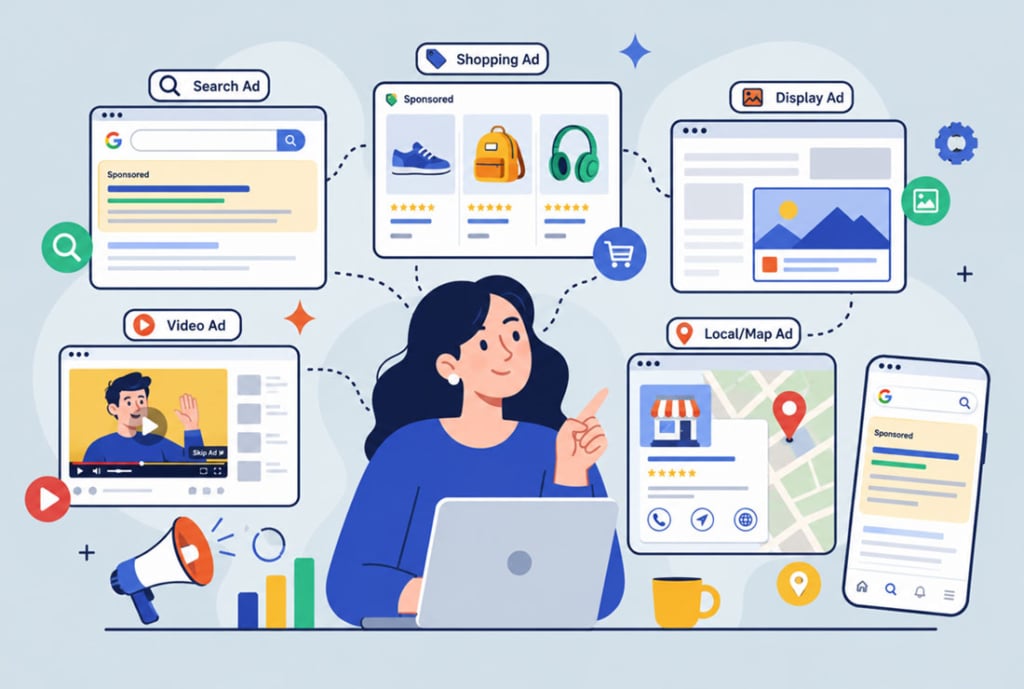
Many business owners assume every Google Ad appears at the top of search results. In reality, Google offers several campaign types, each designed to help businesses reach potential customers in different ways.
Some campaigns connect with people who are actively searching for a product or service. Others help businesses build awareness, reconnect with previous website visitors, or promote products directly within Google.
Understanding the different types of Google Ads and where they appear can help you make better advertising decisions and set realistic expectations for your campaigns.
What are the different types of Google Ads?
Google Ads includes six primary campaign types that most businesses will encounter:
- Search Ads: Text ads that appear in Google Search results when people search for relevant keywords.
- Display Ads: Image and banner ads shown across millions of websites, apps, and YouTube.
- Demand Gen Ads: Visually engaging image and video ads designed to build awareness and reach people across YouTube, Discover, and Gmail before they begin actively searching. Google is expanding Demand Gen as the future of many visual advertising features.
- Shopping Ads: Product listings that showcase products, prices, and store information in Google Search and Google Shopping.
- Remarketing Ads: A targeting strategy that uses ads across multiple campaign types to reconnect with people who have already visited your website or interacted with your business.
- Performance Max Campaigns: AI-powered campaigns that can place ads across Google’s network, including Search, Display, YouTube, Gmail, Maps, Discover, and Shopping.
Each campaign type is designed for different business goals. The sections below explain where each one appears, how it works, and when it makes the most sense to use.
Google Search Ads: Where they appear and how they work
Search Ads are the most familiar type of Google Ad. These text-based ads appear when someone searches Google for a product or service using specific keywords.
Where they appear: Above or below Google’s organic search results when someone searches for relevant keywords.
What triggers them: Searches for products, services, or questions such as “roof repair near me,” “family dentist Portland,” “website design company,” or “best Thai restaurant.”
Who sees them: People who are actively searching for the products or services you offer. Because users are already looking for a solution, Search Ads often reach people with high purchase intent.
Best for: Businesses that want to generate leads, phone calls, or sales from people who are actively searching for what they offer.
Google Display Ads: Reaching customers across the web
Display Ads are visual ads that appear across Google’s Display Network, which includes millions of websites, mobile apps, YouTube, and other online platforms. Unlike Search Ads, they aren’t triggered by what someone is searching for at that moment.
Where they appear: On websites, blogs, news sites, eligible YouTube placements, mobile apps, and other online content. These are the banner ads, graphics, and image-based promotions you see while browsing the internet.
What triggers them: Google displays these ads based on factors such as a person’s interests, browsing behavior, location, the content they’re viewing, or whether they’ve previously visited your website.
Who sees them: People who match your target audience while they’re browsing online. For example, a homeowner reading about remodeling might see a decking company’s ad, or someone researching furnace problems may see an HVAC company’s ad.
Think of display ads like digital billboards. You only see a billboard if you’re driving down that road. Online, that “road” is the websites, apps, and content someone is interacting with.
Best for: Building brand awareness, promoting special offers, staying visible in your local market, reaching potential customers before they’re actively searching, and reconnecting with previous website visitors.
Note: Display campaigns aren’t going away, but Google is putting more of its focus on Demand Gen. As the platform evolves, many new visual advertising features will be introduced there first.
Google Remarketing Ads: Reconnecting with interested customers
Remarketing Ads are designed to reconnect with people who’ve already interacted with your business. While remarketing isn’t a separate Google Ads campaign type, it’s a powerful targeting strategy that can be used across several campaign types to encourage previous visitors to return.
Where they appear: Across the Google Display Network, including websites, YouTube, mobile apps, and sometimes Gmail.
Who sees them: People who have previously visited your website, viewed specific pages, or interacted with your business online.
What triggers them: When someone visits your website, they can be added to a remarketing audience. Google can then show your ads to those users as they browse other websites, watch YouTube videos, or use supported apps, helping keep your business top of mind.
Best for: Re-engaging potential customers who didn’t convert on their first visit, promoting special offers, encouraging repeat visits, and reminding people to come back when they’re ready to take the next step.
Performance Max campaigns: Using AI to reach customers across Google
Performance Max campaigns (PMAX) use Google’s AI to automatically place your ads across multiple Google platforms. Instead of creating separate campaigns for each platform, you set your advertising goals, and Google determines where your ads are most likely to generate results.
Where they appear: Across Google’s network, including Google Search, the Display Network, YouTube, Gmail, Discover, Maps, and Shopping.
What triggers them: Google’s AI automatically decides where your ads are most likely to perform based on factors such as search intent, interests, online behavior, and your campaign goals.
Who sees them: People who are most likely to take the action you’ve optimized for, whether that’s submitting a contact form, making a purchase, calling your business, or visiting your location.
Best for: Businesses that want to maximize conversions across Google’s advertising channels without managing separate campaigns for each platform.
Search Ads vs. Display Ads: What's the difference?
Although Search Ads and Display Ads are both part of Google Ads, they serve different purposes and reach people at different stages of the buying journey.
| Search Ads | Display Ads |
|---|---|
| Triggered by keywords people search for | Triggered by audience targeting |
| Appear in Google Search results | Appear across websites, apps, and YouTube |
| Reach people actively looking for a solution | Reach people while they're browsing online |
| Primarily text-based | Primarily image-based |
| Best for generating immediate leads or sales | Best for building awareness and staying top of mind |
Neither campaign type is better than the other. They simply solve different marketing challenges. Search Ads help you capture existing demand from people who are actively searching for your products or services, while Display Ads help introduce your business to potential customers before they begin searching.
Most successful Google Ads strategies use both campaign types together to reach customers throughout the buying journey.
How to choose the right Google Ads campaign
Choosing the right Google Ads campaign starts with identifying what you’re trying to accomplish. Are you looking to generate leads, sell products online, build brand awareness, or re-engage with previous website visitors?
The clearer your goal, the easier it is to choose the campaign type that best supports it.
If you’re just getting started, avoid trying to do everything at once. Most businesses see better results by starting with one or two campaign types, measuring performance, and expanding over time.
For example, a service-based business may begin with Search Ads to reach people actively looking for its services, then add Demand Gen or Display Ads to build awareness and Remarketing Ads to stay in front of interested prospects.
If you’re not sure which approach is right for your business, working with an experienced Google Ads partner can help you build a strategy that aligns with your goals and budget.
Why you might not see your own Google Ads
If you don’t see your ads when you search for your business, don’t panic. Typically, searching for your own business isn’t a reliable way to confirm whether your ads are running. Factors such as location targeting, search terms, budget, ad scheduling, and Google’s optimization can all impact when an ad appears.
Instead, review campaign data such as impressions, clicks, conversions, calls, and leads to understand how your ads are performing. For a closer look at why your ads may not appear in a particular position or search, check out our blog: Why Isn’t My Business Ranking Higher in Ad Placements?
Making the most of your Google Ads campaigns
There isn’t one “best” type of Google Ad. Each campaign type is designed to help businesses reach potential customers at different stages of the buying journey. The right strategy depends on your goals, your audience, and how you want to connect with people.
If you don’t know which Google Ads campaign is right for your business, Stellaractive can help. We’ll work with you to develop a strategy that aligns with your goals, reaches the right audience, and helps you get the most from your advertising budget.
Contact us or give us a call at 503-384-2413 to learn more about our Google Ads management services.